
TL;DR: An AI content marketing workflow runs a piece through eight stages, research, brief, expert insight, drafting, review, optimization, distribution, and measurement, in one connected place. AI carries the mechanical work at each stage. People make the judgment calls. Most teams spread these stages across nine different tools, so context leaks at every handoff. The fix is shared context between stages.
Content marketing works best when every stage of the process shares context with the next. Research informs the brief, the brief guides the draft, reviews happen before publication, distribution supports the campaign, and performance data shapes the next piece. An AI content marketing workflow brings these stages together while leaving the strategic decisions in human hands.
Most teams do not run it that way. The brief lives in a doc. The draft lives in another tool. Review happens over email. Distribution happens in a scheduler that knows nothing about the campaign the post belongs to. By the time a piece ships, it has passed through nine different tools, and context leaks at every handoff. The research the writer needed never made it into the brief. The brand voice notes never made it into the prompt. The performance data never made it back to whoever writes the next one.
This piece walks through what each stage of the workflow looks like when it is done well, using the workflow we actually run on Boki as the example throughout. The point is not the number of tools. The point is whether each stage shares context with the next.
Where content workflows actually fall apart
The breakdown is rarely one big failure. It is a series of small handoffs that each lose something.
A brief gets written once at the start of a quarter and never updated as the strategy shifts. Three weeks later a writer opens it, and it is describing a priority the team has already moved past. The writer follows it anyway, because the brief is the instruction, and nobody flagged that it went stale.
A writer starts from a blank page because the research that justified the piece lives somewhere they cannot easily find. It is in a Slack thread, or a shared doc someone forgot to link, or in the head of the strategist who is on PTO. So the writer reconstructs it from memory and a few quick searches, and the draft drifts away from the angle that made the topic worth covering.
A draft sits in review for a week because the only person who can catch a technical inaccuracy has eleven other things on their plate. The piece is not blocked on quality. It is blocked on one person’s calendar, and there is no way to move it forward without them.
Distribution then happens on a separate schedule that has no idea what campaign the post belongs to. It goes out as a standalone post, disconnected from the launch it was meant to support, and the team measuring the launch never counts it. Each of these is a real handoff, and each one is where the workflow quietly breaks.
What the workflow looks like stage by stage
A workflow that holds together has a clear shape. Each stage has a job that AI can carry and a decision that stays with a person. The table below is the spine of the rest of this article. Each stage gets its own section after this, so you can read any one of them on its own.
| Stage | What AI Handles | What Stays Human |
|---|---|---|
| Research | Gathering and synthesizing real-time information | Which angle is worth pursuing |
| Brief creation | Structuring the brief from the research | What the brief should actually ask for |
| Expert insight | Capturing and organizing SME input | Which insight changes the argument |
| Drafting | Producing a first pass grounded in the brief | Whether it sounds true to the brand |
| Review | Flagging technical and clarity issues | Whether the piece is ready to ship |
| Optimization | Checking structure for AI search visibility | Whether the framing still serves the reader first |
| Distribution | Scheduling across channels | Where and when it actually belongs |
| Measurement | Tracking how each piece performs | What that performance means for the next brief |
Read across any row and the division of labor is the same idea repeated. AI does the gathering, structuring, flagging, and scheduling. The person sets the direction and confirms the judgment. The stages that follow show what that looks like in practice.
Starting from real research
Good content starts with understanding what people are already talking about. Too often, research begins with a few Google searches and ends with a document full of links that quickly go stale. By the time a writer starts drafting, they are working from information that no longer reflects what is happening in the market.
In Boki, research starts by defining the topic you want to monitor. Add a seed keyword and Boki suggests related terms. From there it tracks conversations across multiple platforms, so instead of manually checking different communities and search results, you have one place to see what people are discussing, the questions they are asking, and the topics gaining momentum.
AI handles the repetitive work of discovering and organizing those discussions. The decision that stays with the team is which opportunities are worth pursuing. A dozen threads might point in different directions, but only one of them aligns with the audience, the product, and the story you want to tell.
That decision becomes the foundation of the brief. When the research reflects what people are actually saying instead of assumptions, the writer begins with a clear angle rather than a blank page.
That choice of angle is what the brief has to carry forward, which is where most of them go wrong.
Building a brief writers actually use
The conversations you reviewed in Opportunities tell you what to brief. When you prompt the Boki agent to draft the content brief, you start from what the market is actually saying rather than a blank template. The agent structures that input into a first draft: the angle, the audience, the questions to answer, the claims to support. What it produces is a starting structure, not a finished brief.
The decision that stays with you is what the brief should actually ask for. The agent can structure what it is given, but it cannot know that one angle fits the quarter’s strategy and another does not, or that a claim needs softening because the product does not do that yet. You shape the draft into the brief the piece needs, and a brief writers actually use sits between two failures. Too vague, and the writer fills the gaps with guesses until the draft wanders. Too rigid, and the writer stops thinking and just fills in blanks.
A brief that works gives clear direction without removing judgment. It answers the questions a writer has before they start: who this is for, the one thing it has to land, and what to leave out because it belongs in a different piece. It tells the writer where to go while leaving room for the calls that come up in the writing. That balance is what carries into the draft.
Getting real expertise into the piece without a six-email thread
A brief tells the writer where to go. Expert insight is what makes the argument worth trusting when they get there. Subject matter experts rarely have time for a long back and forth. An engineer, a founder, or a product lead has the one insight that makes a piece credible, and they have about ten minutes to give it. A workflow that asks them for a meeting, then a follow-up, then a review pass, will get their input late or not at all. The expertise exists. The process for capturing it is what fails.
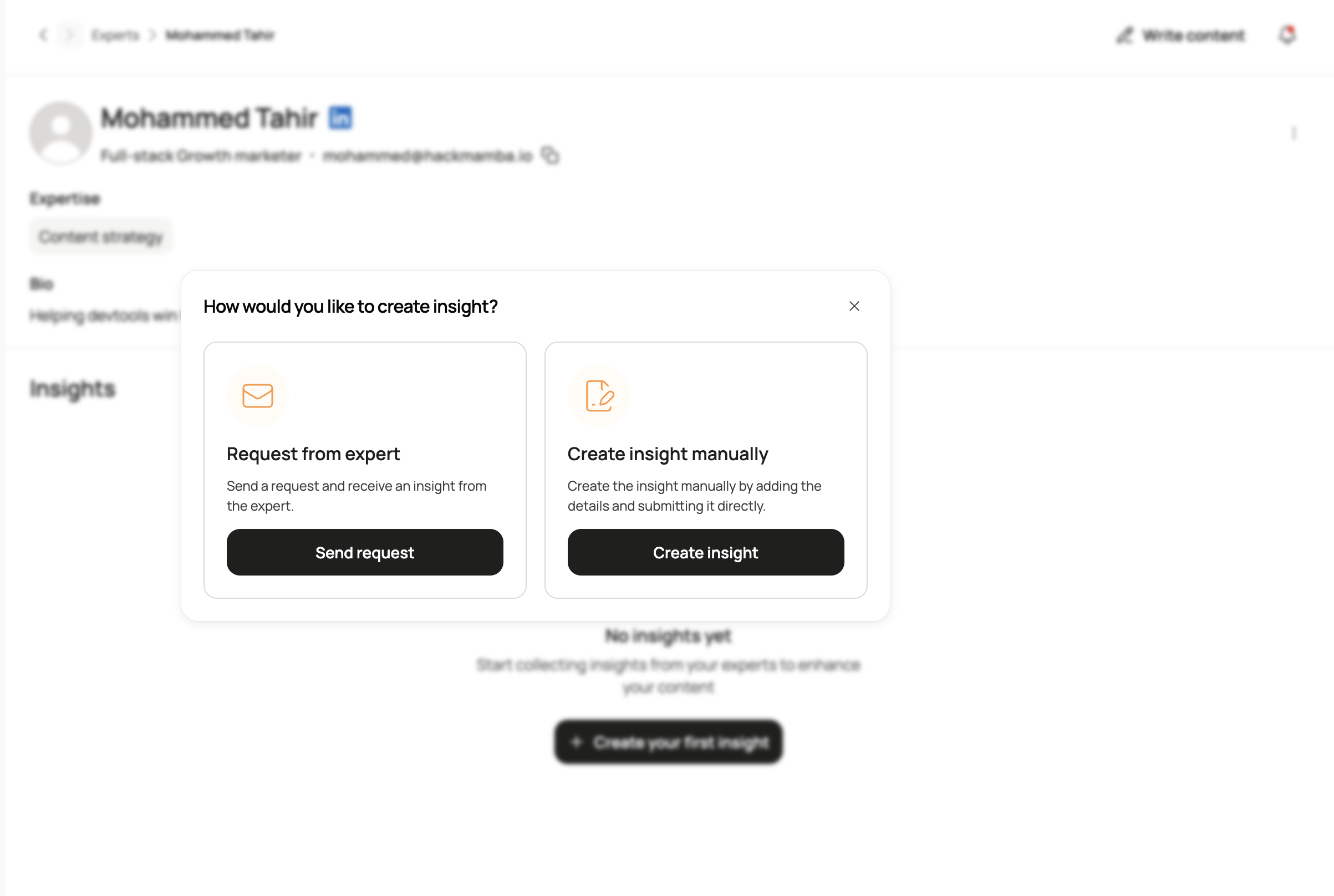
In Boki, experts live in the workspace as profiles, and you capture their input as insights two ways. You can request an insight by sending the expert a topic and the key question you need answered, and they respond without a meeting or a long thread, or you can add the insight manually when you already have what they said. Either way the insight is saved against that expert and ready to pull into a piece, instead of sitting in someone’s inbox.
The reason that input needs to live in the workspace is the same reason the brief does. Expertise captured in a separate thread gets summarized, then paraphrased, then lost. When it sits with the rest of the work, the writer builds from what the expert actually said, and the person reviewing later can check the draft against the real source. Which insight changes the argument is the call you make. Experts often give more than the piece needs, and someone has to know which point is the one worth building around.
Why AI-assisted drafts still need to sound like a person wrote them
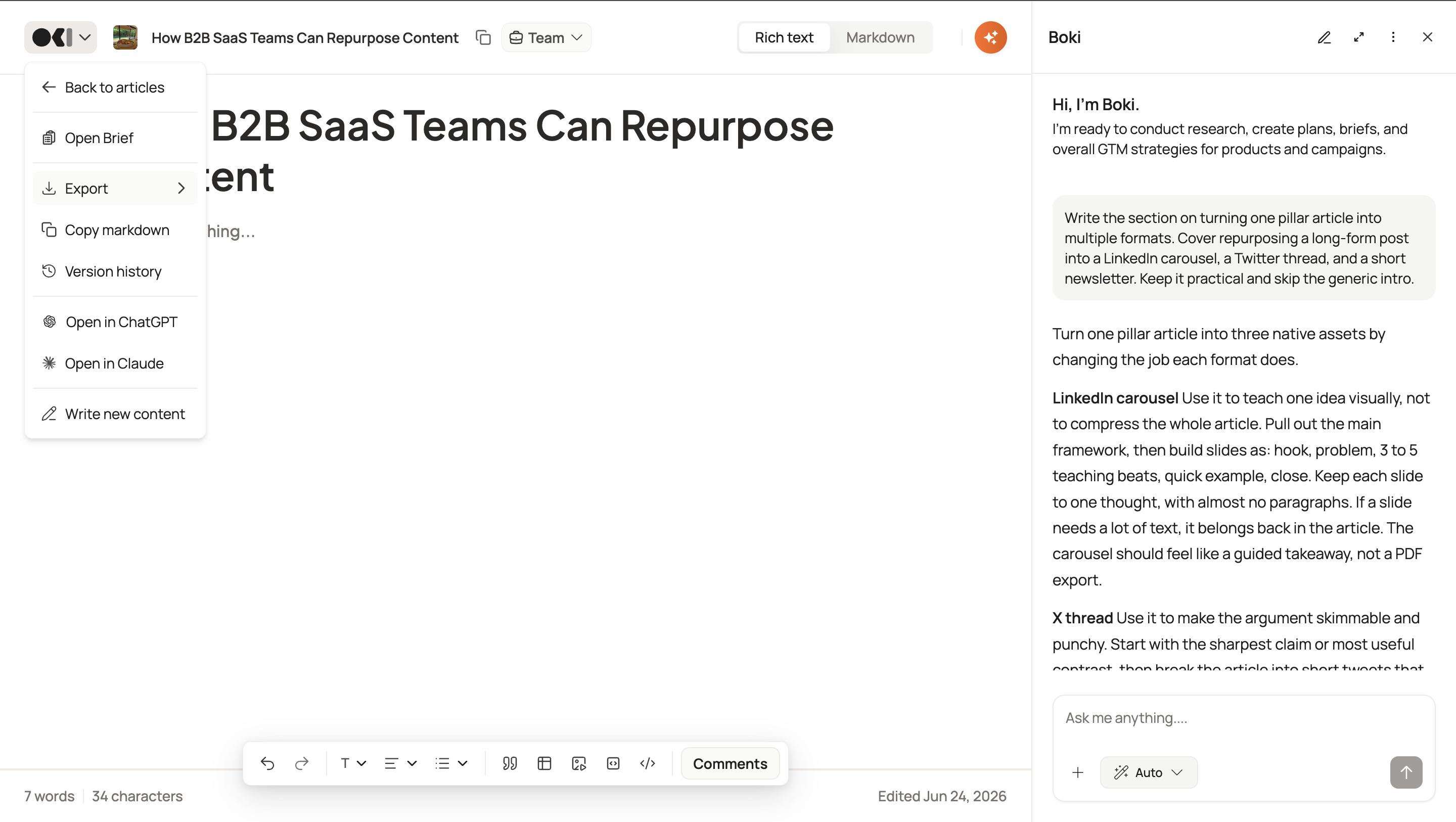
With the angle chosen, the brief in place, and the expertise captured, the writer finally has enough to draft from. In Boki you create the article straight from the brief, so the draft starts from the work you already did instead of a blank page. The brief stays a click away while you write, and you can ask the agent inside the article to generate a section whenever you need a first pass to react to.
Once you are writing, the risk is brand voice, and it slips for reasons that are easy to name once you have watched it happen a few times. The prompt has no context, so the model writes generic. The draft gets generated section by section and published without anyone reading it end to end, so the slip never gets caught.
Telling a model to be “clear and confident” produces clear, confident sludge, which is why the context carrying into the draft matters more than any instruction you could write. Because the brief stays attached while you write, each section the agent produces starts from the angle and the claims you already set, and you are editing toward that instead of starting cold. The model gives you a first pass to react to. The voice comes from the editing.
A model can match a register. It cannot know that a particular phrase is one the founder would never use, or that a joke lands wrong for this audience. A person has to read it and make that call. That read is non-negotiable, which is also what the review stage is built around.
What changes when AI catches the first round of issues
By the time a draft reaches a human reviewer, most of the catchable problems should already be caught. A reviewer’s attention is the scarcest thing in the workflow, and spending it on a misspelled product name, a broken claim, or a missing disclosure is a waste of it. Those are exactly the issues AI can flag before a person looks at the piece.
In Boki, you can run reviewer agents over a draft before you hand it to a human reviewer. A messaging review agent checks that the piece says what the brief asked it to say, flagging where the draft drifts from the angle or makes a claim the brief did not set up. A technical review agent does the same for accuracy, checking the claims and details a non-specialist reviewer might miss. Run them and the draft you pass on has already been read once, with the obvious problems surfaced and marked.
The shift this produces is in what the human reviewer is doing. When the mechanical pass is already done, their job moves from finding problems to confirming judgment calls. Instead of reading every line hunting for the error an agent would catch, they look at what got flagged and decide which issues matter, then make the one call that was always theirs to make.
Optimizing for search engines and AI answers at the same time
Content gets found in two ways now, and the same structural choices serve both. Search engines still reward clear structure and direct claims. AI answer engines pull from pieces that state things plainly, organize information into self-contained sections, and make claims that can be lifted and cited without the surrounding paragraph. A piece written to be quotable by an AI answer is usually also a piece written to be skimmed by a person.
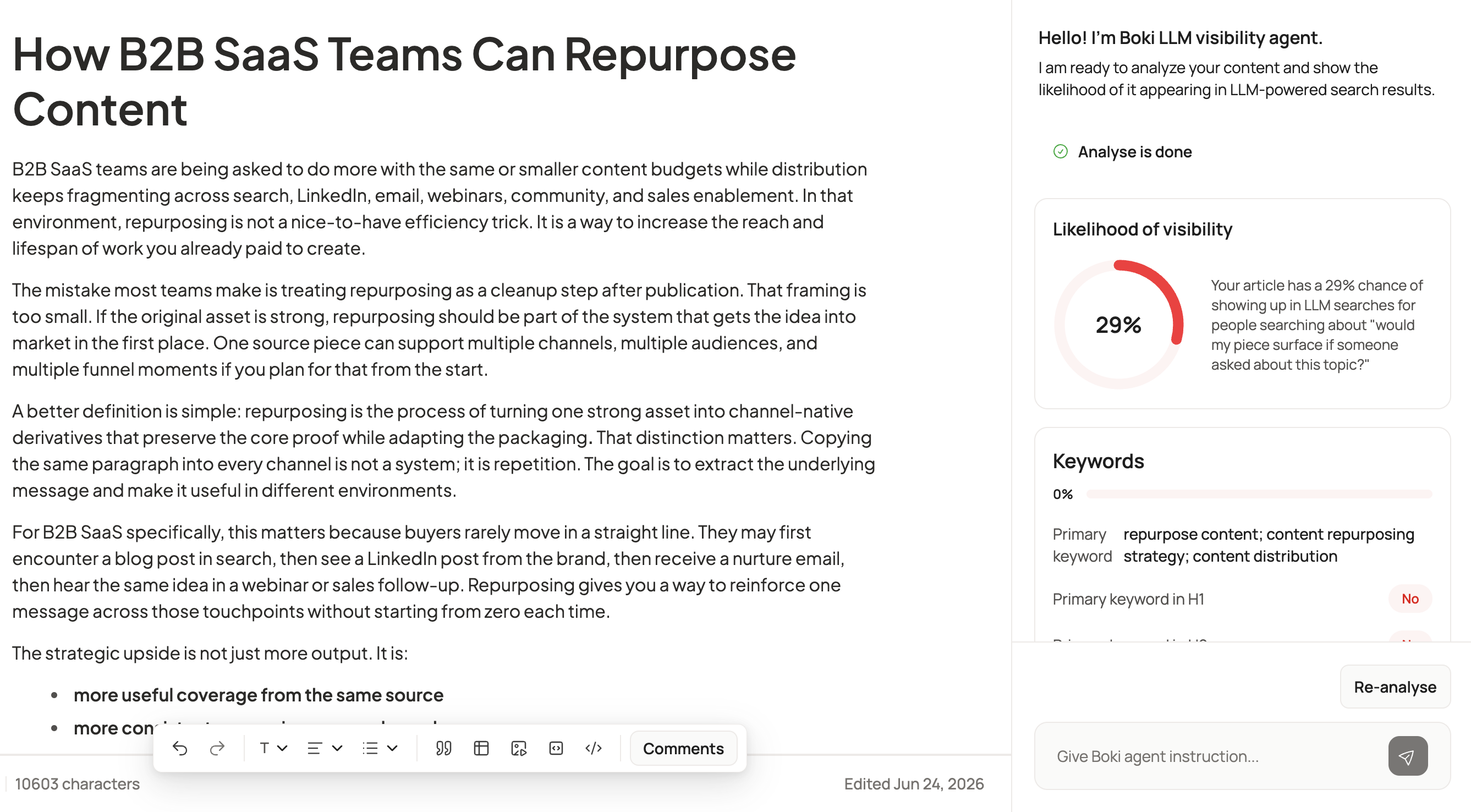
In practice this means naming things precisely, leading sections with the answer before the explanation, and keeping each section able to stand on its own. In Boki, you can run an LLM visibility agent over a draft. You give it the topic and the query you want the piece to surface for, and it checks the draft against that query: whether your keywords land in the H1 and the section headings, how often they appear, and what is missing. It returns a score and specific fixes, so whether a piece is structured to be found becomes something you check before publishing rather than guess at.
What the agent cannot tell you is whether the framing still serves the reader first. A piece can be optimized into something an engine surfaces and a person finds hollow, and someone has to make sure that did not happen. Once the piece is structured to be found, the question becomes where it actually goes.
Getting the piece in front of people without losing the thread
A post with no connection to the piece it came from is just a post. It goes out, it gets some impressions, and nobody can say what it was part of or whether it did its job. Scheduling itself is easy. Plenty of tools schedule a post to a channel. What they do not do is carry the context of why the post exists.
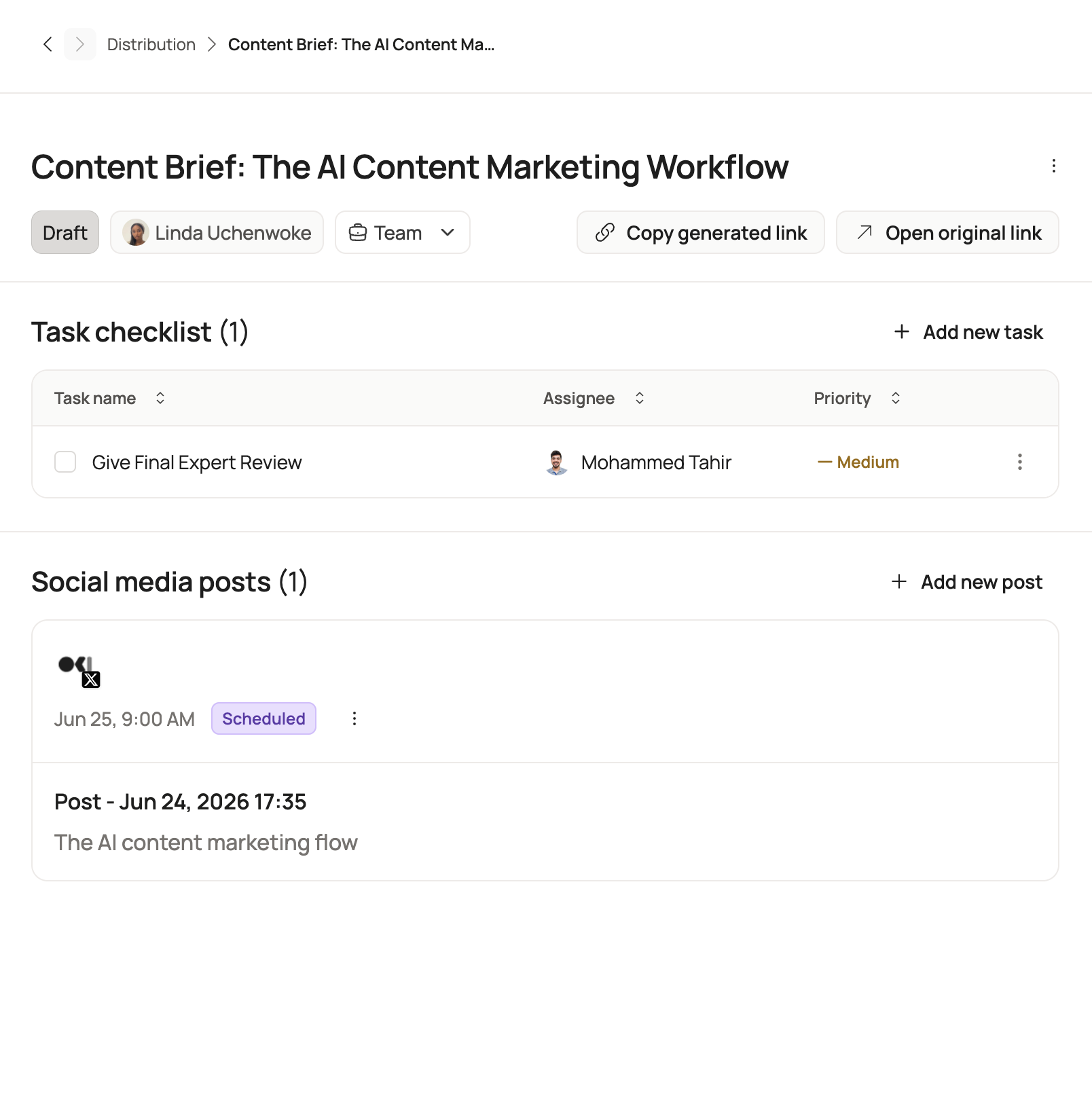
What changes when distribution shares context with the rest of the workflow is that the post stays connected to the piece and the brief that started it. In Boki, distribution sits on the content item itself, so the social posts you create live alongside the article they promote, and you schedule them to your connected accounts from there. The post knows what it points to. Which channel fits the audience and which moment fits the campaign is still your call, but the thread from brief to published piece to promoted post does not break at the last step.
That connection is also what makes the final stage possible, because you cannot measure what you cannot trace.
Letting performance data shape the next brief
Performance data is only useful if it reaches the people writing the next brief. Most teams have the data somewhere. It sits in an analytics tool that the strategist checks once a month and the writers never see. The loop that should run from performance back into the next brief is open, so the same weak angles get briefed again and the strong ones never get reinforced.
The mechanical work AI carries here is tracking how each piece performs once it is out, tying the numbers back to the content that produced them. In Boki, every published piece gets its own performance view: total clicks over time, and a breakdown of where the audience came from, by country and region, and what they read on, by device and browser. The decision that stays human is what those numbers mean for the next brief. A piece that pulled steady traffic from your core market and a piece that spiked once and went quiet are telling you different things, and only a person reading them in context can say which lesson to carry forward.
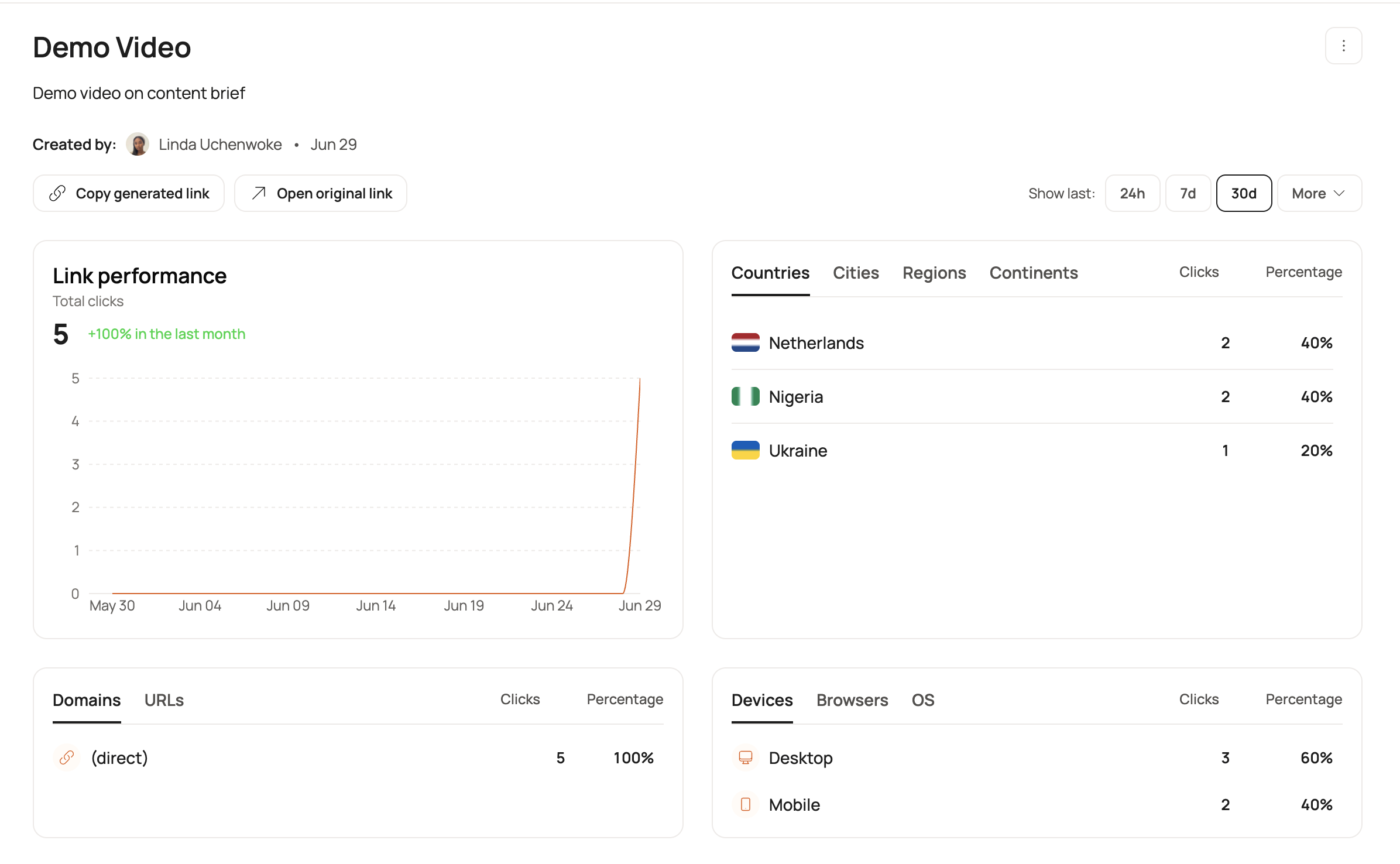
What closes the loop is keeping that performance data in the same workspace as the briefs. When the person writing the next brief can see how the last three pieces on the same topic performed, they stop briefing the weak angle twice. The feedback that used to live in a separate dashboard becomes part of the place where the next piece begins. That is the full loop, and it only holds because a person is reading the signal at the end of it.
What AI should never be deciding on its own
The walk-through above hands a real job to AI at every stage. It is worth being just as direct about what AI should never be deciding on its own, because that line is what keeps the workflow honest.
Which angle is worth the team’s time stays human. The research can surface every direction a topic could go. Choosing the one that fits the strategy requires knowing the strategy, and that knowledge does not live in the model. Whether a piece actually sounds like the brand stays human. Brand voice breaks in ways that are obvious in retrospect and invisible during generation, and someone reading the full piece before it ships is the only reliable catch. Whether a draft is ready to ship stays human. The agents flag issues. A person weighs them and makes the call, because shipping is a judgment about acceptable risk, not a checklist.
And what a result actually means for strategy stays human. The numbers are facts. The lesson is an interpretation, and interpretation is the work. AI handles the mechanical weight of each stage, the gathering, structuring, flagging, scheduling, and tracking. People decide what matters. A workflow that gets that division right is one where the team spends its attention on the calls that deserve it and stops spending it on the work that never did.
Frequently asked questions
What does an AI content workflow look like?
It runs in eight stages: research, brief creation, expert insight, drafting, review, optimization, distribution, and measurement. AI handles the mechanical work at each stage, the gathering, structuring, flagging, and scheduling. People make the calls that require judgment, like which angle to pursue and whether a piece is ready to ship.
How do we keep brand voice consistent when AI is part of the writing process?
We keep the brief and product context attached to the draft itself, so the writer is editing toward the angle and claims already set rather than re-establishing context on every edit. Then a person reads every piece end to end before it ships. The read is the safeguard that catches what the model cannot feel.
What makes a content brief effective?
A brief that gives clear direction on the angle, audience, and claims, while leaving the writer room to make the judgment calls that come up while writing. It works best when it lives in the same place the writer is about to work, so the direction stays attached to the draft instead of being read once and forgotten.
How should AI be used in content review?
To catch technical and clarity issues before a human reviewer sees the draft. That shifts the reviewer’s job from finding problems to confirming judgment calls, which spends their attention on the one decision that was always theirs: whether the piece is ready to ship.
What tools do you need for a content marketing workflow?
Fewer than most teams think. The workflow needs research, briefing, writing, review, distribution, and performance to share context with each other. The number of tools matters less than whether they pass context cleanly, and that shared context is usually the real gap.
Conclusion
The workflow works when each stage shares context with the next. Research grounds the brief, the brief stays attached to the draft, the expertise stays attached to the brief, the distribution knows what it is distributing, and the performance data reaches the person writing the next piece. AI carries the mechanical weight at every stage, which is what frees a team to spend its attention on the calls that actually require it: the angle, the voice, the decision to ship, and the meaning of a result.
The point was never fewer people in the loop. It is people pointed at the work only they can do. Boki is built to run this workflow. You can start on the free plan and run a piece through the full eight stages without a credit card.