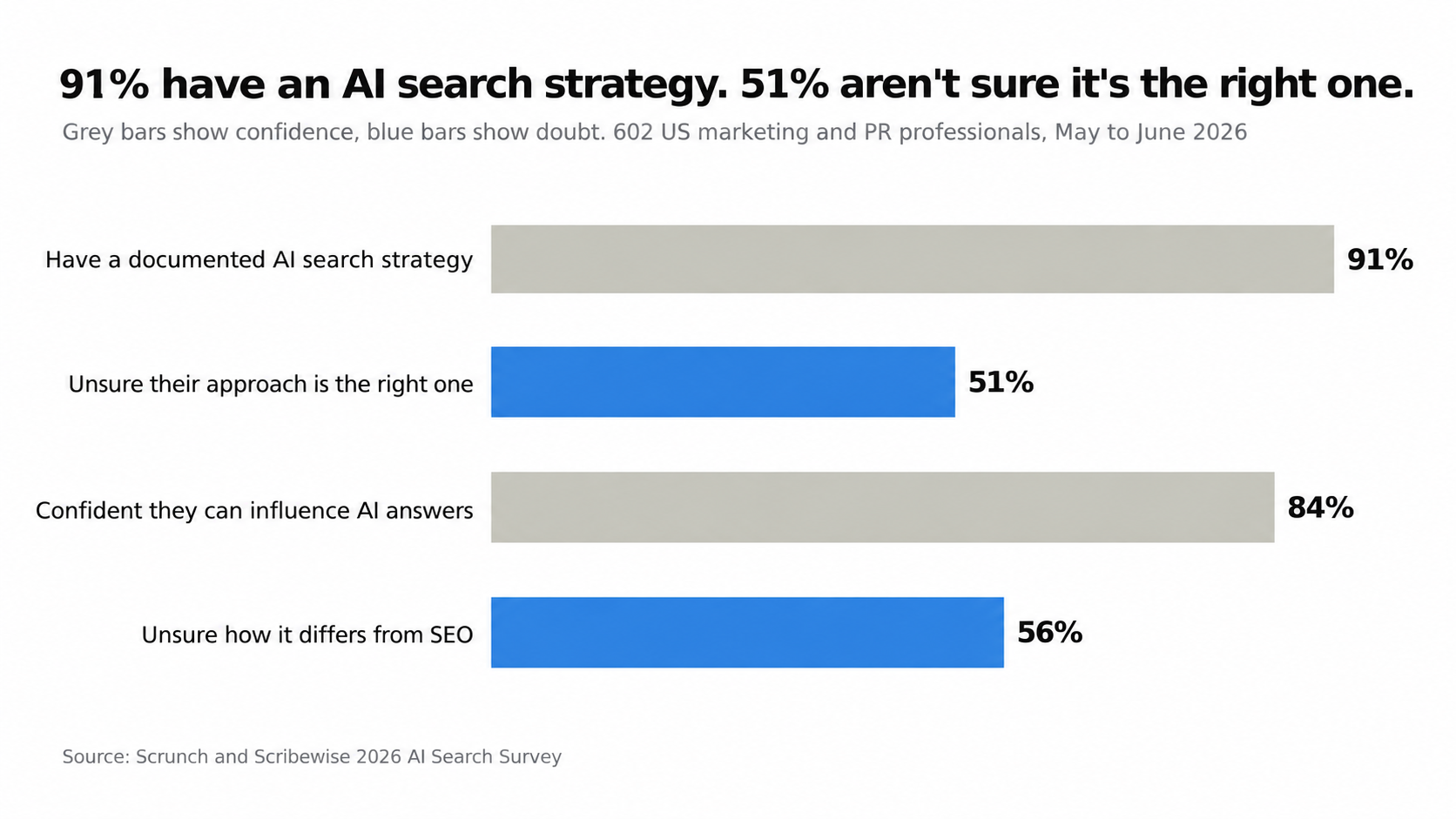
Most marketing teams now have an AI search strategy, and half of them doubt it’s the right one. In a May to June 2026 survey of 602 US marketing and PR professionals by Scrunch and Scribewise, 91% said their team has a documented AI search strategy, and 51% weren’t sure it was the right one. Scrunch sells AI-visibility software and Scribewise sells GEO services, so both have a stake in how that gap is read.
That doubt matters because AI search now shapes which brands make the shortlist. In G2’s March 2026 survey of 1,076 B2B software buyers (G2 runs a review marketplace), 51% said they start their research with an AI chatbot more often than with Google, and 69% said a chatbot led them to a different vendor than they had planned. Forrester’s State of Business Buying, 2026 also describes genAI search as a starting point for B2B buyers.
Clicks are drying up at the same time. According to SparkToro’s analysis of Similarweb data, 68.01% of US Google searches ended without a click in early 2026. A brand missing from AI answers can lose a deal before its sales team knows the opportunity existed.
To find out what’s actually working, we spoke with seven practitioners. They are Kaleigh Moore, creator AEO strategist; Gaby Arora, content marketing manager at Bitly; Chinenye Ozowara, content manager at Quillmop; Rohit Singh, founder of GeoZ AI and The GEO Community; Al Sefati of Clarity Digital; Rocío Berardo, growth manager at Hackmamba; and Mohammed Tahir, senior growth marketer at Hackmamba.
We asked each of them a similar set of questions. Each section below opens with the question, followed by their answers and a short read of where they land.
When did AI search become real work?
We asked when AI search stopped being something to watch and became something to work on. For each of them, there was a specific moment.
Chinenye Ozowara
The shift happened when I started watching organic traffic on content I’d written decline. … I found that people weren’t clicking through anymore. … The summary is that I pivoted because the traffic decline made the decision for me.
Kaleigh Moore
I got passed over for two full-time roles because I didn’t have the AI skills I needed to get hired. That and my content agency workload pretty much disappeared; I knew something had to change.
Mohammed Tahir
Before AI Overviews, all I wanted was to get into the top 3 positions. … Being in the top 3 still matters, but the impact isn’t the same anymore because ranking in the top 3 doesn’t necessarily guarantee that your content or brand will be referenced.
Rocío Berardo
Last year, it wasn’t on everyone’s mind. … In 2026 it became something every client talks about and wants to track, from founders to sales people.
The triggers were different. Chinenye and Mohammed saw it in performance, with traffic falling and top rankings that no longer guaranteed a mention. Kaleigh felt it in the job market, and Rocío saw it in client demand.
None of them waited for an industry report to confirm the shift. By 2026, founders and sales teams were asking about it too.
For most teams, the first signal is already in their own data. A ranking that holds while traffic falls usually means buyers are getting their answers somewhere else. Each of the people we spoke to treated that as the moment to change how they work.
What are you actually optimizing for?
We asked whether marketers should optimize for traffic, citations, brand recommendations, visibility, or something else.
Kaleigh Moore
Brand recommendations, with citations and brand representation within answers as the leading indicator of success. Traffic from AI answers is real but small and inconsistent, so if that’s your north star you’ll undervalue the whole channel.
Chinenye Ozowara
I’d rank brand recommendation first, and citations second. … You can be cited without being recommended. Recommendation is the bigger win, because it means the model has learned who you are, not just what you wrote.
Mohammed Tahir
Brand recommendations, because that’s what ultimately drives revenue.
Gaby Arora
I think marketers need to be optimizing for all those things! … If your content is strong but your reviews are sparse, then you’re not going to get recommended no matter how well-written your content is. You must fix the weakest link first.
Al Sefati
I think marketers first need to understand the huge difference in the way AI platforms retrieve and process data. … Then marketers need to have different KPIs to meet, before they start doing anything.
Most of them would optimize for brand recommendations. Three of the five pick them, and Mohammed gives the plainest reason, that recommendations drive revenue.
Kaleigh and Chinenye add a useful distinction. A citation is how a brand earns a recommendation, so citation share is worth tracking as the leading indicator.
Gaby’s answer is the most practical. Audit where your presence is weakest first, because thin reviews can cancel out strong content. Al’s caution applies to all of it. Set KPIs per platform, since each one retrieves and surfaces brands differently.
Can anyone trust the numbers?
Measuring AI visibility is harder than measuring search rankings. SparkToro’s research found AI tools rarely return the same brand recommendations twice, so a single check can mislead. Traffic is hard to trace too. Loamly, which sells AI traffic analytics, found 70.6% of the AI traffic it identified would show up as Direct in GA4, with no sign it came from AI.
We asked how they measure AI search visibility, and how much they trust the numbers.
Kaleigh Moore
I use AirOps most often to track a defined prompt set across models, and I care most about three things: share of voice on the prompts that map to real buying questions, which sources get cited when we show up (and when competitors show up instead), and whether the model’s description of the brand is accurate. … I trust trends more than snapshots. AI answers are volatile, so any single result is noise.
Gaby Arora
It’s difficult to truly understand what the numbers mean since every platform reports differently, making true comparison hard. I expect that to change as measurement standards mature, but for now it’s directional.
Rocío Berardo
I think the main issue is that there’s not one source of truth to measure AI visibility. … I think the most common concern is “why my competitor is showing and we’re not.”
Mohammed Tahir
I don’t think there is any attribution problem, there is a tool for every use case now literally, we just need to look for one.
Al Sefati
We use various tools, mainly industry tools, but we look at the data those tools provide with a grain of salt. The key is being able to measure impact on the business.
Four of the five describe the same limits. No single source of truth exists, and platforms report differently. Answers also change from one run to the next.
Their workaround is consistent. Track a fixed set of prompts over weeks, look at which sources get cited, and judge success by business impact over any single visibility score.
Mohammed is the outlier, arguing the right tools already exist. The gap between his view and Rocío’s, inside the same team, shows how unsettled measurement still is. Until tracking vendors show how their numbers are calculated, trends are more trustworthy than scores.
Is GEO new, or is it SEO with a new name?
Jeremy Moser of uSERP told Digiday that AI visibility is 80% fundamental SEO, yet Ahrefs found that only 38% of pages cited in AI Overviews rank in Google’s top 10, down from about 76% a year earlier. Ahrefs sells the tool the data came from.
Rohit Singh
GEO is a data science problem, not a content creation problem. … Much of what people are doing today amounts to rolling the dice: creating various pieces of content and hoping something works.
Chinenye Ozowara
SEO optimizes for a ranking position on a page a human clicks through to and reads. GEO optimizes for being selected and pulled into an answer that a human reads directly inside the AI platform, without ever visiting the original page.
Gaby Arora
It’s an extension, not a replacement. … AI platforms reward the same signals good SEO always has, just packaged differently: cleaner metadata, clearer chapters, more citable answers.
Mohammed Tahir
I don’t really see GEO and SEO as separate things. Strong SEO still matters, but what’s changed is where you need to be visible. … Optimising for Google can improve visibility in Gemini, while Bing can influence visibility in ChatGPT, and so on.
Kaleigh Moore
Most of it is fundamentals. … What’s new is the weight given to where your brand appears beyond your own site. … So the playbook is familiar, but the team that runs it needs to be broader.
Three of the five see GEO as an extension of SEO, and their reasoning lands on the same point. The fundamentals hold, and the places a brand needs to show up have multiplied. LinkedIn and review sites now matter, and so do the search engines LLMs draw on.
Chinenye and Rohit call it a separate discipline for different reasons. For Chinenye, the content has a different job. For Rohit, it is a data problem. Rohit runs a GEO company and didn’t share results, which is worth weighing.
For most teams, the practical move is to give the existing SEO and content team a bigger map before hiring for a new discipline.
What have they actually changed?
We asked what they’ve changed in how they approach content, and what evidence they’ve seen.
Chinenye Ozowara
The first lines of my introductions answer the core question directly. … My subheadings are now phrased as questions rather than statements, matching the way people actually query AI platforms. … In my experience, full topic coverage has brought the most results.
Gaby Arora
For our YouTube strategy, I now build content around citability, not just readability, tightening metadata, adding structured chapters, and writing answers AI can lift cleanly.
Kaleigh Moore
In practice, for B2B the best “creators” are usually already on your payroll. We identify the subject matter experts whose knowledge maps to the prompts buyers are asking, help them publish consistently on LinkedIn and other platforms models pull from.
Al Sefati
We put heavy focus on our clients being present across other channels, and we monitor reviews, ratings, and sentiment, which are even more of a factor than before. … These are all in addition to classic SEO.
Rocío Berardo
I had to explain that LLMs synthesize consensus across the broader web, so if independent developers, forums, and documentation do not validate your product, a clever web page tweak will not save you.
The changes that came with evidence were small and specific. Chinenye’s answer-first structure and full topic coverage, and Gaby’s metadata and chapter tweaks tested against citation rates, are things any content team can try this quarter.
Kaleigh and Al moved effort off the brand’s own site, toward employees publishing on LinkedIn and toward reviews and PR. That’s where AI answers increasingly draw from.
Rocío’s client story is the warning. A few clever phrases won’t help if independent sources don’t back the product.
What’s being oversold?
We asked what’s most overhyped about AI search right now.
Kaleigh Moore
The biggest overcomplication is chasing technical tricks: special file formats, prompt-stuffed pages, gaming individual answers. It’s a lot of effort for fragile wins.
Al Sefati
Reddit is overhyped. It’s a platform you should monitor for sentiment and feedback, but LLMs aren’t about Reddit. … For SaaS, you want to focus on G2, Capterra, and so on.
Rohit Singh
There’s too much investment in PR and Reddit. They can work for certain queries because LLMs favor diversity across sources. But diversity is only one factor, and it isn’t the primary one.
Mohammed Tahir
I think AI citation and visibility metrics are being overhyped a bit. It’s useful to know how often you’re mentioned or cited, but a citation by itself doesn’t mean you’re generating demand or revenue.
Chinenye Ozowara
Honestly, I don’t think anything is overhyped right now. GEO is still new. … The ideas that keep working and show real results will become the real GEO methods.
Hacks and shortcuts top the list, such as prompt-stuffed pages or a separate content engine just for AI search. Reddit splits the group. Al and Rohit think it gets too much attention, while Kaleigh still counts it among the places a brand needs to show up.
Mohammed’s pick is the most pointed, since visibility metrics are what many AI search tools are built to sell. Chinenye offers a different view. The field is young enough that much of today’s hype is really experimentation, and the methods that keep producing results will outlast the rest.
Where they landed
Here’s where each of the seven stands. These are interview answers, not survey data.
| Practitioner | Optimize for | Trust in metrics | GEO: new or SEO? | Most overhyped |
|---|---|---|---|---|
| Kaleigh Moore | Brand recommendations, citations as the leading indicator | Trends over weeks, never snapshots | Mostly SEO fundamentals, run by a broader team | Technical tricks |
| Gaby Arora | All of it, weakest link first | Directional only | Extension of SEO | Throwing out the SEO playbook |
| Chinenye Ozowara | Brand recommendations, then citations | Conditional | New discipline | Nothing yet |
| Rohit Singh | Citations and faithfulness | Measures against query fan-out | New, a data science problem | PR and Reddit |
| Mohammed Tahir | Brand recommendations | High, no attribution problem | Same thing as SEO | Citation and visibility metrics |
| Al Sefati | KPIs set per platform | With a grain of salt | SEO fundamentals, plus reviews and reputation | |
| Rocío Berardo | Brand recommendations, as clients want | No single source of truth | Clients now see it alongside SEO | Quick keyword fixes |
Key takeaways
-
Aim for brand recommendations. Kaleigh, Chinenye, and Mohammed all put being recommended first, and treat citations as the way to earn it.
-
Fix your weakest channel before creating more content. Gaby found thin reviews can cancel out strong content. Al says the right review sites depend on your category, such as G2 for SaaS or Yelp for a local business.
-
Track a fixed set of buying-question prompts over weeks. Kaleigh trusts the trend across weeks, never a single answer. Gaby, Rocío, and Al also treat today’s numbers as directional, though Mohammed thinks the right tools already solve this.
-
Restructure what you already have. Chinenye answers the core question in the first lines, phrases subheadings as questions, and covers each topic fully. Gaby applies the same thinking to YouTube metadata and chapters.
-
Show up beyond your own site. Kaleigh gets in-house experts publishing on LinkedIn, and Mohammed points out that Bing visibility feeds ChatGPT, so ranking on Google alone isn’t enough.
Two views still need proving. Rohit says the real gains sit in data science work most teams aren’t doing yet. Mohammed says measurement is solved, and expects SEO and GEO to merge into “a single Brand Marketing function” by 2027. Rocío expects the fight to move to measurement instead:
Within a year the argument will shift from ‘how do we get cited’ to ‘whose citation number do we trust,’ and the teams that started running their own repeatable prompt sets early will be in a great position.
We built Boki to help content teams see what to create or improve next, and turn their experts’ knowledge into content that search engines and AI tools can find and cite.