
In an era where attention is the ultimate currency, email marketing remains a powerful tool for brands. It’s not just about sending messages; it’s about building meaningful connections. By leveraging data-driven insights, businesses can unlock new levels of engagement and drive sustainable growth.
Have you read something like this recently? It’s typical AI slop. Look for one claim you could check or act on, and you won’t find one. “Attention is the ultimate currency” has no source, “meaningful connections” names no tactic, and “new levels of engagement” gives no number. Each sentence sounds like advice and leaves you with nothing to do.
In a September 2025 survey of 1,150 US desk workers, 40% said they had received AI-generated “workslop” in the past month. Each instance took an average of one hour and 56 minutes to resolve, and the senders paid for it too: 42% of recipients saw the sender as less trustworthy, and 50% saw them as less capable (Harvard Business Review, September 2025).
Content teams face the same risk in public. When a reader spots slop in a post, they judge the brand that published it.
To avoid AI slop, give the AI a specific brief with real sources and your own point of view, then treat its output as a first draft. Check every claim, cut filler, add examples only your team could know, and have a human editor review it before it ships.
What is AI slop?
AI slop is low-quality content produced in bulk with AI tools and published without real review. Merriam-Webster named slop its 2025 Word of the Year and defines it as “digital content of low quality that is produced usually in quantity by means of artificial intelligence.” The American Dialect Society also chose slop as its 2025 Word of the Year.
For content teams, slop shows up wherever publishing runs at volume: blog posts, LinkedIn updates, newsletters, and help docs. It usually comes from a workflow that skips steps. Someone prompts for a draft, nobody checks the claims or adds an example, and the draft ships as written.
An AI draft that a person has fact-checked, edited, and filled with examples from their own work is a normal first draft. Slop is what you get when that same draft ships before anyone does that work.
How to spot AI slop
I group the signs of AI slop into three sets: language, structure, and substance. Each sign below has a short example and a fix.
Language signs
These are the words and phrases readers notice in the first paragraph.
| Sign | Example | Fix |
|---|---|---|
| Generic opener | ”In today’s fast-paced digital world, content is king.” | Open with the reader’s problem or your finding. |
| Contrast framing | ”It’s not just a tool, it’s a whole new way to work.” | Say what the thing does in one direct sentence. |
| Filler and stock words | ”Leverage this robust, seamless solution to unlock growth.” | Replace each word with the specific action or result, or cut it. |
| Hedging | ”This might potentially help some teams improve results.” | Commit to the claim. If it’s uncertain, say so once. |
| Dash overuse | A paragraph where every sentence hangs an aside off a dash. | Give an aside that matters its own sentence and cut the rest. |
Structure signs
These show up in rhythm and formatting, even when every word is fine.
| Sign | Example | Fix |
|---|---|---|
| Repeated sentence starters | ”You open the draft. You read the intro. You find nothing new.” | Lead with the action or result, and vary how sentences begin. |
| Same-length sentences | Four sentences in a row of about 12 words each. | Let length follow the thought. Put a short sentence after a long one. |
| Groups of three | ”Scalable, reliable, and developer-friendly.” | Keep the one that matters and make it concrete. |
| Random bold | ”Get results with zero effort in just minutes.” | Remove the bold and let sentence order carry the emphasis. |
| Emoji bullets | A rocket or sparkle emoji at the start of every bullet. | Delete them and let the words do the work. |
| Summaries that repeat | ”In this post, we covered the signs, the fixes, and the checklist.” | End with a next step, or cut the section. |
Parallel structure isn’t always a problem. Keep it when readers are comparing real options or following steps.
Substance signs
These are the hardest to spot and the most damaging, because the draft can read well and still be wrong.
| Sign | Example | Fix |
|---|---|---|
| Claim with no source | ”Most readers can spot AI content instantly.” | Link the source, narrow the claim to what it supports, or cut it. |
| No specific example | ”Many teams have improved their content with better review.” | Name the team, what they changed, and what happened. |
| No point of view | A post that lists every option and recommends none. | Say what you would do and why. |
| Invented details or untested code | A feature the product doesn’t have, or a code sample nobody ran. | Check product claims in the product and run every code sample. |
How to stop AI slop before you draft
Most slop starts before the AI writes a word. A vague prompt gets a generic draft, so fix the inputs first.
Write a brief the AI can’t misread
A good brief gives the AI three things:
-
One named reader. Without one, the AI writes for everyone.
-
The point of view the piece argues. Skip it, and the AI lists every option and recommends none.
-
The sources the AI may use. Without them, it fills gaps with claims that sound plausible and have nothing behind them.
The brief is one step in a longer process. Our AI content marketing workflow guide shows where it sits between planning and publishing.
Get input from someone who has done the work
Before drafting, ask a practitioner:
-
What went wrong the first time you did this?
-
What would you do differently now?
-
What does most advice on this topic get wrong?
Their answers give the draft details the AI can’t produce on its own.
Give the AI rules that ban the signs
Copy this block into your prompt and fill in the brackets.
You are drafting a blog post for [reader]. Use only the sources below.

Rules:
- Open with the reader's problem or a specific finding. No scene-setting openers.
- State claims directly. Don't define anything by what it is not.
- Don't use these words: delve, leverage, unlock, seamless, robust, powerful, landscape.
- Don't use em dashes.
- Vary sentence length and how sentences begin.
- Use bold, emoji, and lists only where they help the reader scan.
- Every statistic and claim must come from the sources below. If no source supports a claim, leave it out and flag it.
- Where a real example is needed, write [EXAMPLE NEEDED] instead of inventing one.
- Don't end with a summary of the post.

Point of view: [one sentence the post argues]

Sources:
[paste links or excerpts]
How to catch AI slop with Boki and deslop-reviewer
Hackmamba’s deslop-reviewer skill runs the language and structure checks from this post on any draft. It’s public on GitHub in the creator-skills repo. Here’s how to use it.
-
Install it. Run
npx skills add hackmamba-io/creator-skills --skill deslop-reviewerfor Claude Code or another agent. In the Claude app, upload the skill as a zip that includes itsreferences/folder. The skill stops and asks you to reinstall if those files are missing. -
Run a review. Paste a draft and ask your agent to review it for AI writing patterns. The skill runs 30 checks, numbered W1 to W30, which cover the language and structure signs in this post. For each problem, it quotes the phrase, names the check, and proposes a rewrite, then sorts the findings by severity so you can fix the High ones first.
-
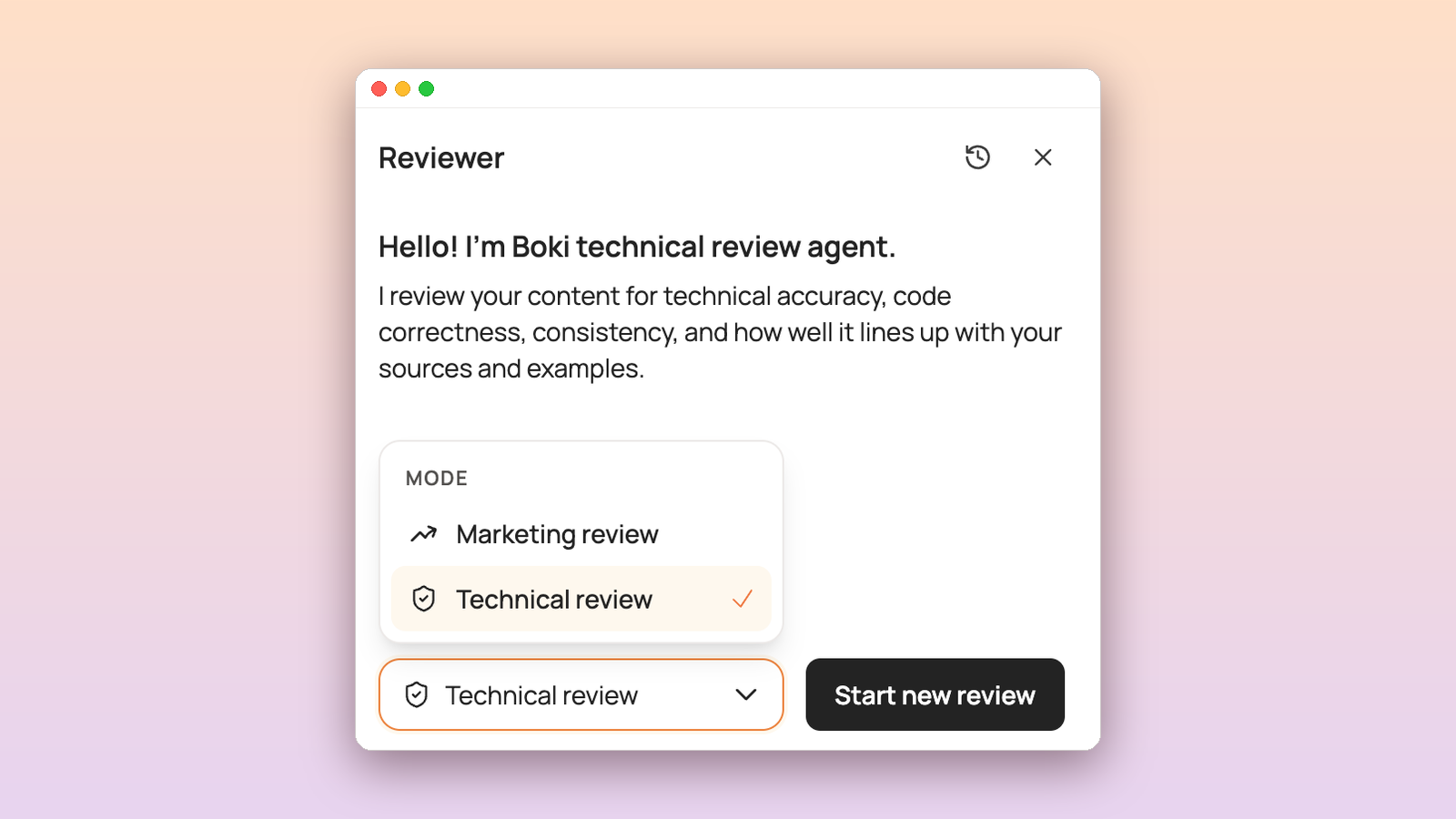
Run it inside Boki. Open the Reviewer in a Boki draft and choose Marketing review. The marketing review agent runs deslop-reviewer’s checks on the draft, so you can catch the writing patterns without leaving Boki.
-
Check substance with Technical review. Switch the Reviewer to Technical review. It checks technical accuracy, code correctness, consistency, and how well the draft lines up with its sources and examples.
New to Boki? Start with What is Boki, or read what a content operations platform does.
AI slop examples: Before and after using deslop-reviewer
Now that you know how to run deslop-reviewer, let’s look at what it actually catches in a draft and how to fix it. Here are two before-and-after examples showing the patterns it flags and the edits that make the writing more specific.
A blog intro
Before
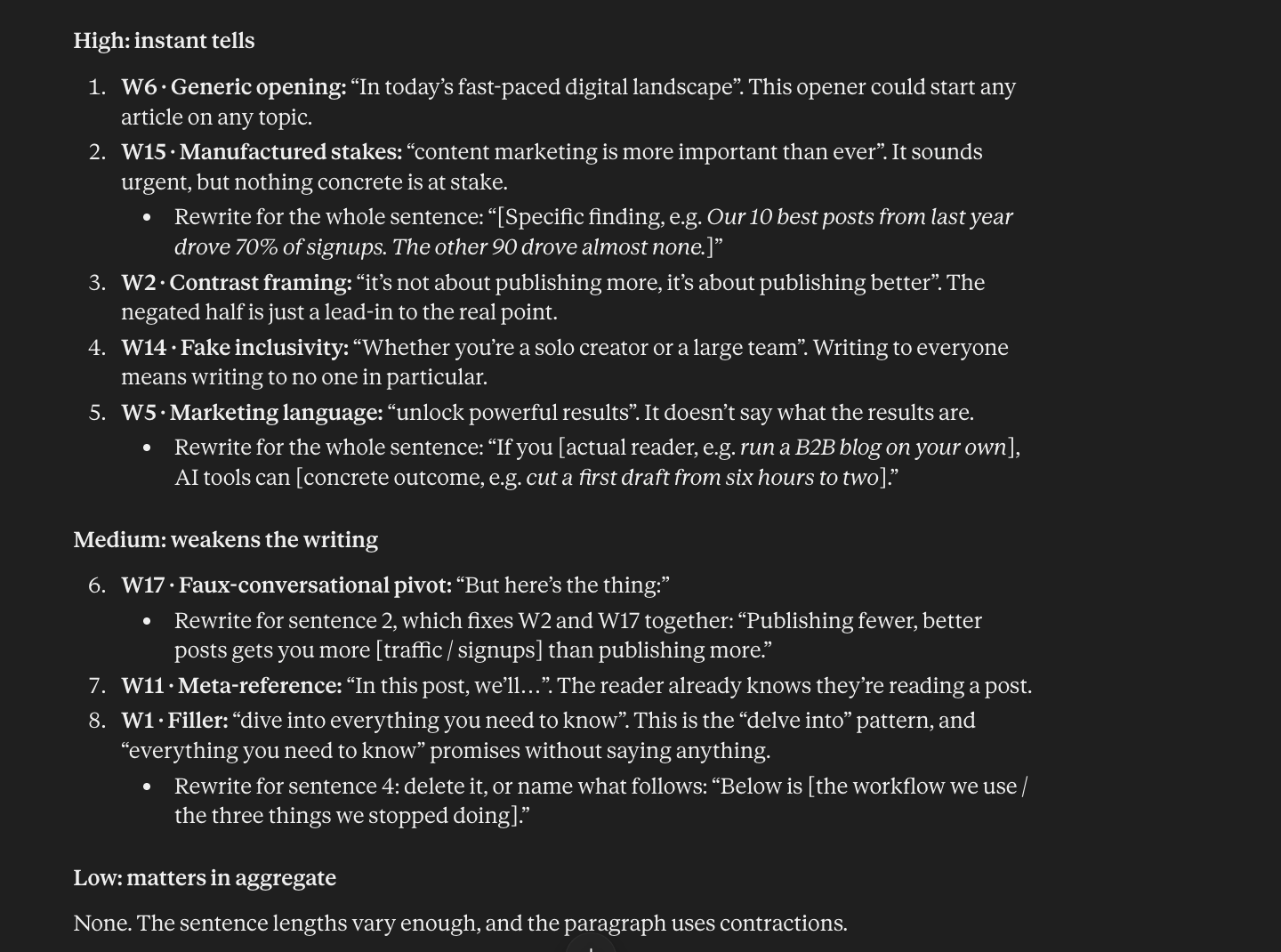
In today’s fast-paced digital landscape, content marketing is more important than ever. But here’s the thing: it’s not about publishing more, it’s about publishing better. Whether you’re a solo creator or a large team, AI tools can help you unlock powerful results. In this post, we’ll dive into everything you need to know.
I ran this draft through deslop-reviewer. It flagged 8 problems, 5 of them High severity:
After
AI tools can turn a brief into a full blog draft in minutes. Publishing more of those drafts won’t help if readers stop trusting them. This post is for content leads who use AI, and it covers how to brief the AI, review its drafts, and publish only what holds up.
What changed
-
Replaced “In today’s fast-paced digital landscape, content marketing is more important than ever” with a specific claim about what AI tools do. The old opener could start any article.
-
Cut “But here’s the thing.” The pivot delayed the point.
-
Replaced “it’s not about publishing more, it’s about publishing better” with the actual risk: readers stop trusting the drafts.
-
Replaced “Whether you’re a solo creator or a large team” with one named reader: content leads who use AI.
-
Replaced “unlock powerful results” and “everything you need to know” with the three things the post covers.
A LinkedIn post
Before
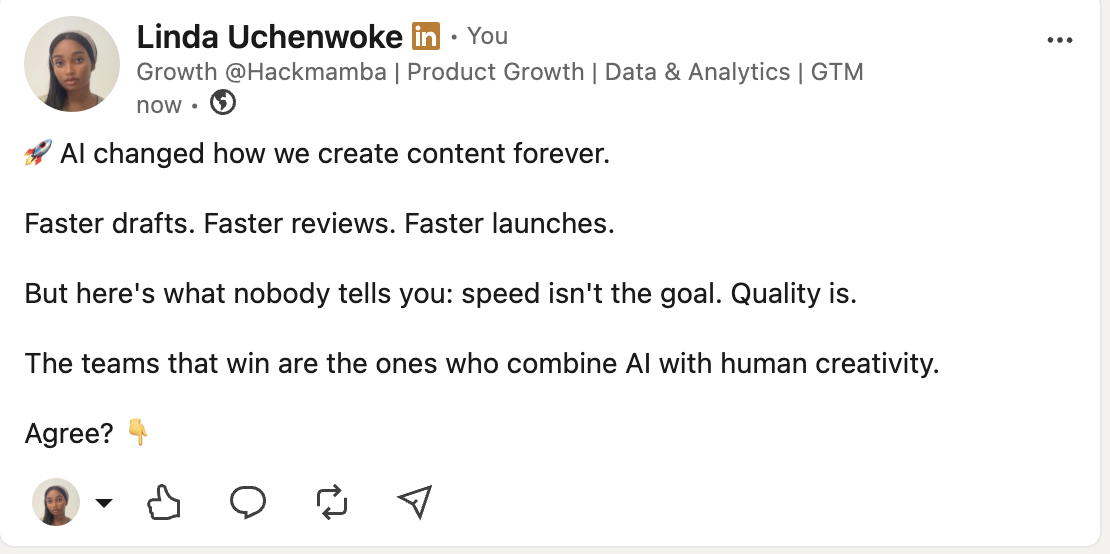
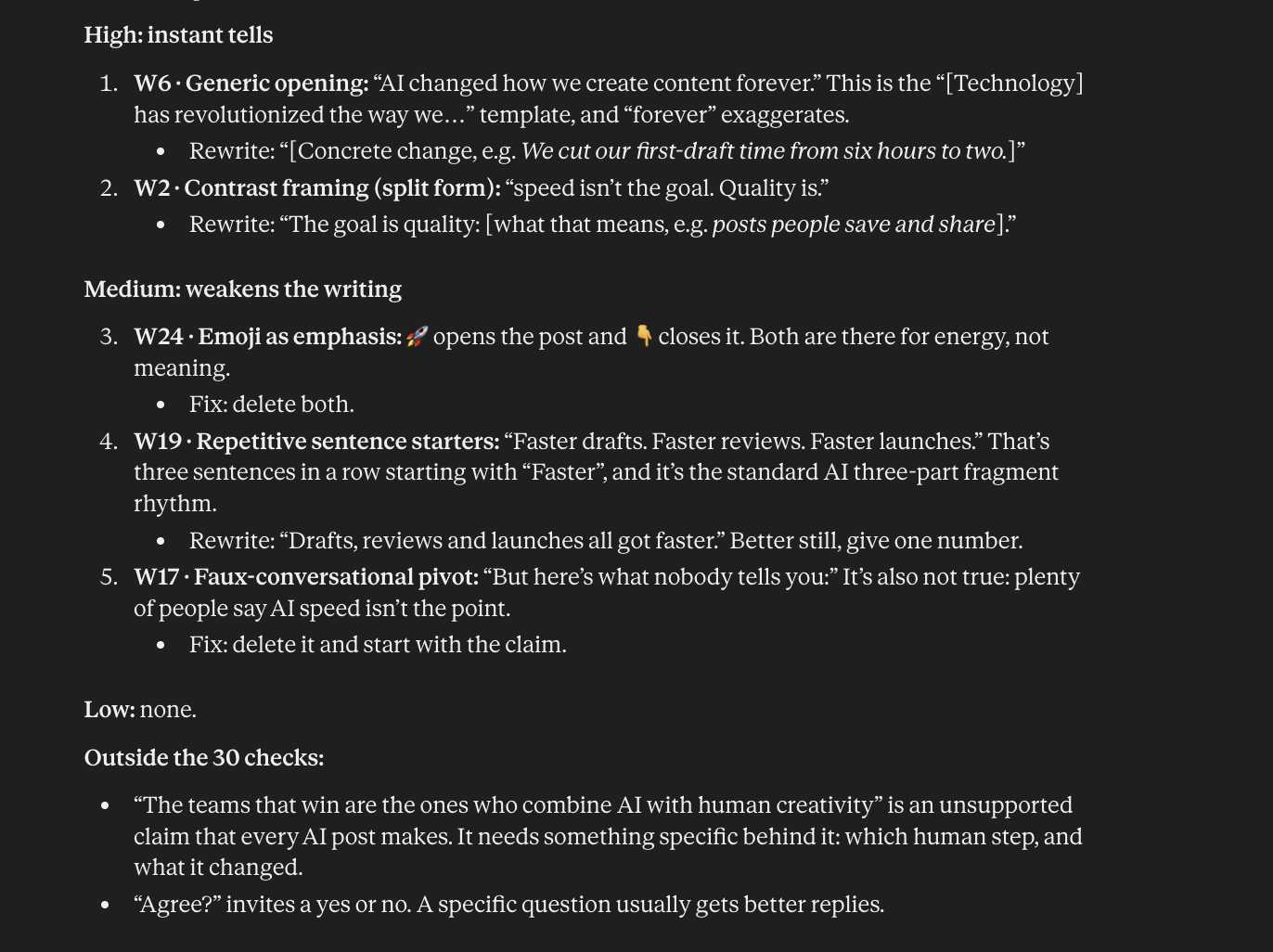
I ran this post through deslop-reviewer. It flagged 5 problems, 2 of them High severity:
After
AI makes first drafts fast. The edit still needs a person: check every claim, cut the stock phrases, and add one example only your team could give. What’s the one edit you make to every AI draft before it goes out?
What changed
-
Removed both emoji. They add energy and no information.
-
Replaced the three “Faster” fragments with one plain claim: AI makes first drafts fast.
-
Cut “here’s what nobody tells you” and the “speed isn’t the goal” contrast.
-
Replaced “human creativity” with the three edits a person actually makes.
-
Replaced “Agree?” with a question readers can answer from their own work.
The examples above show how to catch AI writing patterns in a single draft. But what happens when you’re producing dozens of technical articles for a client? Here’s how Hackmamba used Boki, technical reviews, and human editors to maintain content quality while working with OpenRouter
How Hackmamba kept AI slop out of OpenRouter’s content
Hackmamba, a developer marketing agency, uses Boki alongside technical reviewers, writers, and human editors to maintain content quality for its clients.
For OpenRouter, Hackmamba produced 74 technical articles, each going through a structured review process before publication (case study). Hackmamba’s writers were responsible for fact-checking their own work. They verified product claims, checked documentation, and tested workflows before a draft moved on. Each draft then went through these stages:
-
A technical review agent checked code, API parameters, and product claims.
-
A marketing review agent checked sources, structure, product context, and statements that could mislead.
-
Writers reviewed the agents’ feedback and made corrections backed by evidence.
-
A human editor reviewed technical accuracy, clarity, depth, and repetition.
-
OpenRouter answered final product questions and approved the piece.
Each article shipped with a review guide that recorded the claims verified, the sources used, the corrections made, and the questions still open for OpenRouter.
Kenny Rogers, DevRel Lead at OpenRouter, described the challenge:
Finding time to actually create it in a way that isn’t pure AI-slop. AI works great for scale but still has major quality issues.
AI slop checklist
Run these 10 checks on every draft before it goes to review. Copy them into your brief template or review doc.
-
The brief names the reader, the point of view, and the sources.
-
Input from someone who has done the work is in the draft.
-
Every claim links to a source.
-
The draft has at least one example only your team could give.
-
The opening states the reader’s problem or a finding .
-
There’s no contrast framing, filler, or marketing language.
-
Sentence starters and lengths vary.
-
Formatting carries meaning, with no random bold, emoji, or recap.
-
deslop-reviewer has run, and every High finding is fixed.
-
A human editor has reviewed the piece.
Start with your next draft
Install deslop-reviewer and run it on your next article. Review what it flags, fix the patterns, and check whether your examples and claims hold up.
You can also try Boki’s free Starter plan, which includes unlimited plans and briefs to help you prepare content before writing begins.
Want AI search to cite the content you publish? Read how to get your brand cited by AI.
FAQs
Can AI detectors catch AI slop?
Not reliably enough to replace a review. Detectors can flag human writing as AI-generated, and a score says nothing about whether a piece is sourced or specific. Check the writing against the signs in this post instead.
What are examples of AI slop?
Common examples include openers like “In today’s fast-paced world,” “it’s not X, it’s Y” framing, statistics with no source, and posts that end by recapping themselves. The before-and-after section above shows two full examples.
Is all AI content slop?
No. An AI draft that a person has fact-checked, edited, and filled with their own examples is a normal first draft. It becomes slop when it ships without that review.